“In 1982, a Royal Navy ship was lost because operators emptied their countermeasure arsenal on the first missile. Forty years later, the Navy commissioned its answer.”
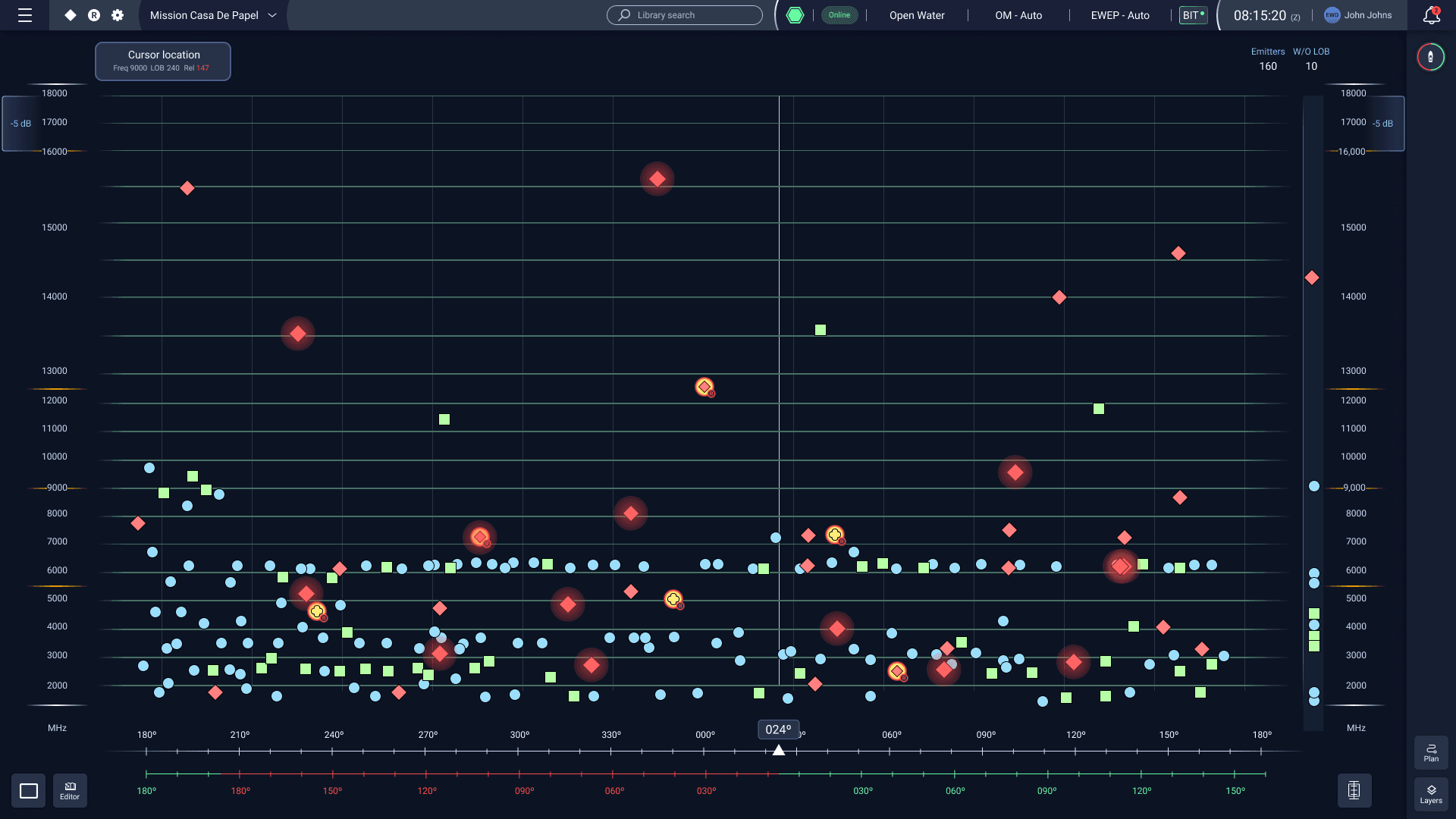
MEWP, the Royal Navy's Maritime Electronic Warfare Programme, is an Electronic Warfare platform for the UK Royal Navy, handling threat detection, classification, and countermeasure deployment in real time aboard destroyers and frigates. The platform spans five sub-systems, each operated by a different role inside the ship's war room. I led UX research and design across all five sub-systems over two and a half years, working with engineers and product managers in Israel and the UK on behalf of Mouse UX. The mandate was unification: five different operators, five different jobs, but one system that felt and behaved consistently across every console. Several components from the work were adopted into the client's design system for future programs. Before the current program shipped, the next increment was already promised back to the studio.
How the system came together.
Embedded with the operators
The work began with weeks of subject matter expert interviews with former Royal Navy officers, end to end review of the system requirements, and task analysis of how work was divided inside the ship's war room. The pattern was consistent: screens were dense, information arrived in arbitrary order, and dealing with a missile threat under pressure was, in their words, "too complicated." Near misses were frequent.
My first instinct was to simplify by reducing what was on screen. The SMEs shut that down immediately - in an EW context, hidden information is dangerous, and a designer removing data is a designer deciding what an operator will not see under fire. That reframed the whole program. The problem was never the amount of data. It was the order in which it demanded attention, which meant I could not buy clarity by taking anything away.
Two cognitive states, one interface
Operators move between two extremes. State 3 is calm monitoring, with rich detail and time to think. State 1 is an active missile threat, where every extra millisecond is a liability. The interface had to compress and expand on demand: surfacing only the most critical decision in State 1, revealing depth in State 3. The flows were designed around the operator's cognitive load, not the system's data model.
The initial concept was a separate threat-mode toggle - a clean-state screen operators could switch into during an attack. In testing, they said they'd never trust a mode they weren't already in. The interface had to be one continuous space.
The "Guitar Hero" timeline
The single biggest design move was a component we called the Guitar Hero bar: a timeline that shows the operator exactly when to fire which countermeasure, in sequence. We placed it at the bottom of the screen, directly above the physical launcher buttons on the console. Eye to button distance dropped to near zero. Reaction time followed.
The first concept was a priority list - highest-threat countermeasure at the top, action buttons alongside each. It was defensible, and operators could follow it. But it asked them to read and re-read under a live threat. The Guitar Hero bar replaced reading with scanning: position on the timeline carries the instruction without a single word. What it cost was familiarity. A ranked list is a pattern every operator already knows, and I traded that for a component nobody had seen before, which had to be earned back in training and testing.
Aggregated alerts, expandable on demand
Even at calm load, the system can be noisy. We grouped alerts and notifications into aggregated components that refused to flood the screen. Each group could be expanded by the operator to reveal full detail, without taking attention from anything else. Information density became the operator's choice, not the system's default.
The standard approach was individual alert cards, one per event. A walkthrough showed the problem immediately - MEWP generates dozens of alerts during a normal watch. The cards filled the screen before a single one was acknowledged.
What we shipped.
The program shipped as a complete system design across all five sub-systems - five operators, five different jobs, one visual and interaction language across every console. Weekly reviews with British and Israeli product managers ran for the full two and a half years. Several core components were adopted into the client's design system for use on future programs. The deliverable package included formal research and strategy documentation and complex programmed prototypes that simulated the full system end to end.
What it changed.
Defense UX taught me that clarity is not decoration. It is the safety constraint. When the cost of a misread is a ship and a crew, every visual decision has to earn its place by reducing cognitive load, not by satisfying a design instinct. The next increment of the program, including the connection and automation of the firing mechanism, was promised back to my studio off the back of this work.

Astra
The Designer Who Shipped the Frontend